Austro-Hungarian Monarchy
Felix AustriaThe Austro-Hungarian Monarchy is the political horizon and the cherished illusion of permanence in Felix Austria. Seen from Stanislaviv, a prosperous yet socially stratified city in Galicia, the empire appears to offer a tolerant, multicultural order; its ceremonies and slogans bind local life to a larger imperial community. But the novel repeatedly sets that confidence against poverty, political violence, coercive authority, and a house consumed by fire, making imperial stability feel less like an established fact than a belief its inhabitants struggle to preserve.
Imperial Galicia and the promise of belonging
The story is set around 1900 in Stanislaviv, one of Galicia’s cultural capitals and a city within the Austro-Hungarian Empire. Its daily life is shaped by a mixture of ethnicities, languages, and religions. That diversity lends the imperial setting a real social breadth, but it does not make its communities equal or erase their conflicts. The imperial ideal is therefore both a historical frame for the city and a promise through which its inhabitants interpret their own place in a changing world.
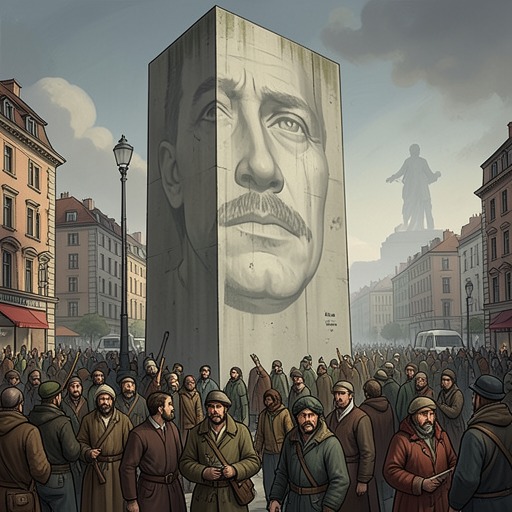
The novel gives the promise a public face in the decorations for Emperor Franz Joseph I’s seventieth birthday. Flowers, banners, flags, and portraits appear on buildings and trees; even the city’s poorer quarters display the emperor’s image and the double-headed eagle. The imperial mottoes Indivisibiliter Ac Inseparabiliter and Felix Austria hang over alleys marked by mud, refuse, and overcrowded courtyards. Their presence makes the distance between official grandeur and material hardship visible: the symbols claim unity, while the streets show how unevenly prosperity is lived.
That contrast complicates the nostalgia associated with the idea of a “happy Austria.” The empire can signify a lost world of relative tolerance, prosperity, and cultural mixture, yet the novel’s Galicia is never simply a harmonious refuge. Its stability is shadowed by social insecurity and by rumors that the imperial order may not endure. The very attractiveness of the ideal makes its omissions consequential: shared ceremony does not itself resolve local deprivation or political vulnerability.
Loyalty, memory, and political argument
A contemporary newspaper account of the birthday celebrations describes the emperor as an exceptional ruler and protector. It recounts Galicia’s long experience of harsh treatment after its incorporation into Austria, then credits Franz Joseph with recognizing the province’s value, understanding its aspirations, and allowing it a voice among the Crown lands. The article presents imperial rule as a corrective to neglect: loyalty is grounded not only in ceremony but in a claimed change in the province’s political standing.
That account is one voice in the book’s broader argument, not a neutral verdict on imperial government. At a gathering in the Anger household, Ernest Thorn turns an international comparison into a deliberately unsettling toast. He invokes American violence in the Philippines, British maneuvering in southern Africa, and the suppression of the Boxers in China, then proposes a toast to Franz Ferdinand and military exercises in Europe. His examples place imperial and great-power language of order alongside episodes of retaliation, intervention, and force.
Petro answers Thorn by repeating Russia’s stated position that the intervention in China should not be called a war: its purpose, the official justification says, is to suppress the uprising and reach an understanding with the Chinese government. Thorn counters that European, American, and Russian powers claim to protect a small number of people they have Christianized and Europeanized against a much larger population seeking to practice ancestral beliefs. The exchange exposes the gap between benevolent explanations of imperial action and the violence those explanations can conceal. It also makes political discussion part of domestic life, where an international crisis is debated across the table rather than kept at a distance.
Public ceremony and private confidence
Imperial loyalty is also performed through the city’s public calendar. For Franz Joseph’s anniversary, a procession sets out from the barracks at half past eight in the evening. It travels through named streets, pauses by the municipal building and the Krona restaurant, and continues along Lindengasse toward the bishop’s residence. The railway orchestra, volunteer firefighters, and crowds of residents turn the celebration into a civic spectacle. Adèle, Petro, and Stefania are caught up in the moving crowd, with the boy in Stefania’s arms, their household carried along inside the larger ceremony.
The procession’s scale and choreography give the empire a tangible local presence: imperial authority is not merely a distant institution but a portrait on a building, a decorated street, and an occasion that assembles townspeople. Yet the same city is changing in less ceremonial ways. Catholic merchants have recently adopted Sunday closing hours, requiring households to plan purchases in advance; modern building practices are replacing wooden structures with brick construction. The novel places these practical adjustments beside imperial ritual, suggesting that ordinary life is being reshaped by social and technological change as well as by political allegiance.
The celebratory surface is further unsettled by the story’s rumors. Stefania hears tales of a prisoner’s death, sorcerers, an Eastern magician, and a widening break between worlds through which creatures supposedly cross. She dismisses the talk as foolishness and reassures herself that the emperor is healthy and clear-minded, while the empire has a secure successor in Franz Ferdinand after the death of Rudolf, the emperor’s only son. Her reasoning makes confidence a personal act of defense: alarming stories are set aside in favor of dynastic continuity, the emperor’s well-being, and the prayers of Father Josef.
Authority and the limits of the imperial order
Imperial power appears not only in slogans and ceremonies but in force. When officials and green-uniformed gendarmes arrive at the Anger household to take the boy, their presence gives the state a direct claim over a domestic life. Petro answers the demand with a practical deception: after the household has spent two weeks feeding the child until he is conspicuously plump, he argues that the boy could not fit into the magician’s hat associated with the case. The officials’ authority is met not with a political challenge but with an improvised household performance that frustrates their purpose.
The episode does not establish a general theory of imperial law, but it shows how state power can enter private space and how the family resists through tactics unavailable in formal political debate. Its comedy depends on the contrast between the black-suited officials and green-uniformed gendarmes, on the one hand, and the child’s newly enlarged body and the hat that will not fit, on the other. The imperial order is formidable enough to send its representatives to the door, yet the scene makes their effort vulnerable to the very material details of the household.
Political life remains contentious even in the later domestic gathering where men argue about municipal and parliamentary elections. The lawyer alleges conspiracy and vote-buying involving a wealthy oil magnate from Solotvyn and the mayor; he is also angered that people debate politics despite being unable to vote under the country’s rules, or having to wait years for that right. The scene places electoral participation and exclusion within the same conversation. Imperial belonging may be publicly celebrated, but political voice is not experienced as equally available to everyone.
The imperial motto and the ending
The most absolute statement of imperial permanence arrives in Stefania’s projection of a future built around feeding others. She imagines her cooking reaching ever more people, crossing the ocean and traveling through Europe, carrying her love to Adèle even at the far end of the world. She calls that love solid, unfailing, and eternal, then compares it to the Austro-Hungarian Empire. The comparison joins domestic devotion to the imperial ideal: both are imagined as enduring bonds that distance and change cannot undo.
The ending places that certainty under immediate pressure. The house Petro designed begins to crack as its strange features melt and collapse; smoke fills the rooms, and objects caught in the flames liquefy and disappear. In the choking smoke, Stefania reaches a clarity she says she has never known and recognizes the illusion in which she has lived. The fire is not described as the empire’s literal destruction, but its juxtaposition with her claim of imperial eternity gives the earlier assurance a starkly unstable echo. A world that seemed permanent is revealed, at the moment of its material collapse, as something its inhabitants had believed into being.
The novel thus holds imperial nostalgia and historical foreboding together rather than resolving them into a simple judgment. The empire offers an image of shared life across a diverse Galicia, and its ceremonies provide inhabitants with a language of loyalty and protection. At the same time, neglected streets, unequal political participation, coercive interventions, and the violence of international affairs expose the costs and limits of that image. Felix Austria makes the phrase “happy Austria” both a cultural memory and a fragile construction: resonant enough to organize hope, but unable to guarantee that the world it names will last.